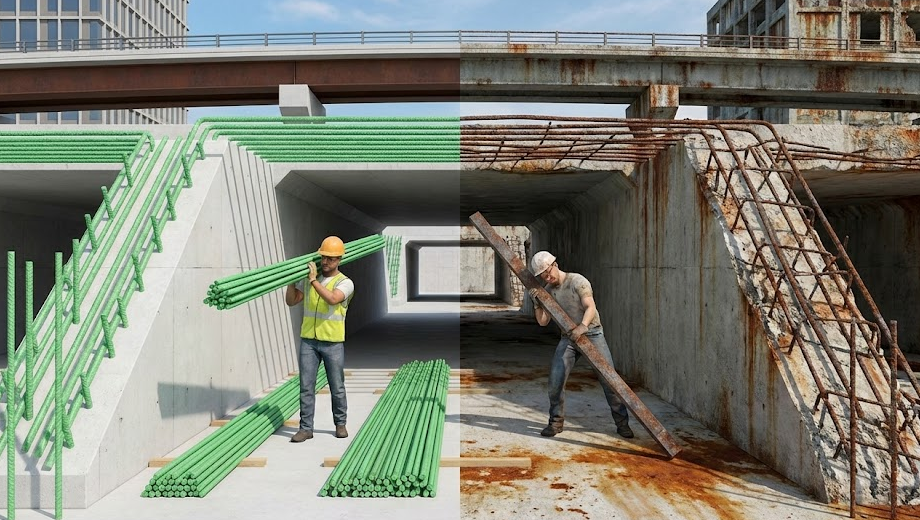
GFRP Rebar vs Steel Rebar: The Complete Comparison for Modern Construction (2026 Guide)
How corrosion-free reinforcement cuts lifetime project cost and risk
For more than 100 years, reinforced concrete structures have relied on steel rebar. It’s strong, familiar, and inexpensive — at least at first. But as soon as moisture, chloride, or chemicals reach steel, corrosion begins. Cracks grow, concrete breaks, structures weaken, and expensive repairs follow.
Today’s construction owners demand long-lasting, low-maintenance infrastructure — especially in sectors like marine, wastewater, bridges, and industrial facilities. That’s where GFRP (Glass Fiber Reinforced Polymer) rebar has emerged as a better alternative.
This guide will help you clearly understand:
- What GFRP is and how it differs from steel
- The true cost of corrosion in concrete
- When GFRP provides higher ROI than steel
- Where GFRP is already replacing steel in the USA
What is GFRP Rebar?
GFRP rebar is a non-metallic reinforcement material made from:
- High-strength glass fibers (for tensile strength)
- Polymer resin (for protecting fibers and bonding)
It’s engineered to deliver superior performance in areas where steel fails — especially corrosion, weight, and lifespan.
Key benefits at a glance
Corrosion-proof
No rust. Zero chloride attack.
High tensile strength
Up to 2X–3X stronger than steel
Lightweight
~4X lighter → lower labor & transport cost
Non-conductive
Ideal for MRI rooms, power plants, rail
Long design life
100+ years durability
GFRP complies with standards such as ACI 440 and ASTM — meaning adoption is quickly growing in US infrastructure.
Why Steel Rebar Fails in Modern Construction?
Steel isn’t a problem — corrosion is.
Concrete absorbs moisture over time. Salt, chemicals, and CO₂ penetrate and attack steel. When steel rusts, it expands up to 7X its size, leading to:
- Concrete cracking and spalling
- Loss of structural capacity
- Safety risks and emergency shutdowns
- Costly repairs and replacements
This is especially severe in:
- Marine and coastal environments
- Bridges & highways exposed to road salts
- Wastewater treatment plants
- Chemical/industrial settings
Every year, corrosion damage costs billions in infrastructure repair across the USA.
GFRP vs Steel Rebar — Feature-by-Feature Comparison
Feature
GFRP Rebar
Steel Rebar
Corrosion Resistance
Completely corrosion-proof
Rusts when exposed to moisture/chlorides
Tensile Strength
2–3X stronger
Moderate
Conductivity
Non-conductive & non-magnetic
Conductive, magnetic
Thermal Conductivity
Low
High
Bond Strength
Excellent with surface sand-coating
Good
Lifecycle Cost
Much lower
Very high in corrosion risk zones
Environmental Impact
Lower lifecycle carbon
Higher CO₂
Where GFRP Wins Big — Applications
Steel may still be okay for short lifespan, low-risk construction. But for critical structures, GFRP delivers maximum value:
Application
Why GFRP Performs Better
Bridges & Highways
No corrosion → DOTs prefer for long-life bridges
Marine & Coastal Projects
100% resistant to saltwater and chloride
Industrial & Chemical Plants
Immune to chemical exposure
Wastewater Facilities
Prevents rapid deterioration of steel
Commercial & Residential Structures
Faster builds + lower maintenance
Healthcare & Labs
Non-magnetic → MRI rooms
LEED Green Buildings
Sustainable + longer service life
Many US state DOTs now specify GFRP rebar in bridge decks and barrier walls to reduce future repair cost.
Cost & ROI — The Real Comparison
Let’s break down the visible vs invisible costs:
Upfront Material Cost
Steel often appears cheaper initially.
But...
Lifetime Cost
Steel structures in high-corrosion environments must be repaired every 10–20 years. Repairs require:
- Shutdowns
- Labor crews
- Concrete demolition and replacement
- Chemical/industrial settings
With GFRP, those costs disappear.
100-Year Service Life ROI Snapshot
Factor
GFRP Rebar
Steel Rebar
Initial Cost
Moderate
Low
Maintenance Cost
Zero corrosion maintenance
High
Repair Frequency
None expected
Multiple
Cost Over 100 Years
Lowest
Highest
Contractors win more bids when offering long-life structures with fixed lifetime cost, not future repair risks.
Safety, Compliance & Code Acceptance
GFRP is now accepted by major US engineering standards:
- ACI 440 — Design guide for FRP in concrete
- ASTM standards — Testing & manufacturing requirements
Government organizations are pushing corrosion-free infrastructure to eliminate long-term taxpayer repair burdens.
When Is Steel Still Used?
To remain realistic and trustworthy:
Steel rebar may still be used when:
- Cost must be absolutely lowest upfront
- Very high-temperature environments (>200°C)
- Projects with shorter design life
Even then — many engineers choose hybrid solutions. Steel + GFRP mixed smartly for best value.
Conclusion
Steel rebar helped build the 20th century — but corrosion-free reinforcement will build the 21st.
GFRP Rebar delivers:
- Zero corrosion
- Longer structure life
- Lower lifetime cost
- Better performance in aggressive environments
To explore how high-quality GFRP rebar can improve ROI in your next project — with compliance to US standards and expert engineering support — visit: www.gogbars.com